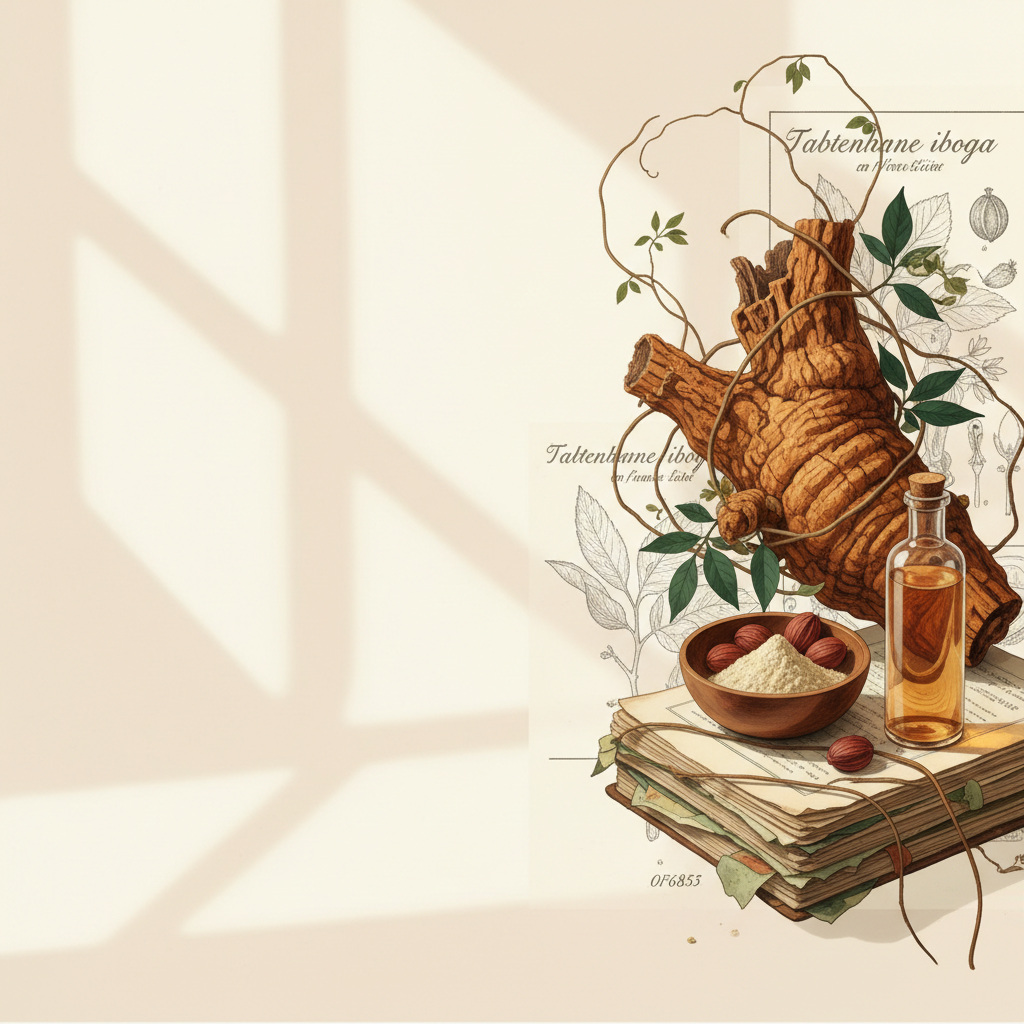
There is a strange quiet around ibogaine. Cocaine has a crowded alias book; heroin has a grim poetry of nicknames; ketamine has drifted into popular slang. Ibogaine, despite its dramatic reputation, has not acquired a stable street name in the usual sense. That absence is not a trivia point. It is the first clue in a larger case file: a Central African plant medicine entered Western pharmacology, addiction treatment, underground clinics, veteran mental-health politics, and state-funded research without passing through the same recreational marketplace that creates slang.
This article treats names as evidence. “Ibogaine” is the alkaloid. “Iboga” is the plant and cultural term. Tabernanthe iboga is the botanical identity. None of these functions like “blow,” “dope,” or “Molly.” The words point backward to rainforest ethnobotany and forward to 2026 policy battles over opioid use disorder, PTSD, clinical trials, and conservation. If you came looking for an ibogaine street name, the honest answer is: there is no widely recognized one. The more useful question is why.
Exhibit 1: the missing street name
Drug slang usually blooms where three forces meet: frequent informal trade, a user base large enough to need coded speech, and a social setting where casual reference matters. Ibogaine has rarely had that ecology. It is not typically a party drug. Its effects are long, physically demanding, and often described as confrontational rather than recreational. A high-dose session may involve ataxia, nausea, closed-eye visions, and a prolonged “life review” state that can last far longer than many psychedelics. That profile discourages the kind of repeat nightlife use that manufactures nicknames.
Modern slang lists, including 2025 drug-alcohol glossaries such as Addiction Center’s, do not show a consistent popular alias for ibogaine. The absence stands out precisely because those same references catalogue dozens of names for common illicit substances. Some searchers assume “iboga” is a street term. It is not. It is closer to an inherited plant name, carried through regional language, ethnography, and botanical classification.
Exhibit 2: where the names actually come from
The nomenclature begins in Central Africa, not in the alley or the clinic brochure. Tabernanthe iboga is an evergreen shrub native to equatorial rainforest regions including Gabon, the Republic of Congo, and the Democratic Republic of Congo. The word “iboga” is commonly linked to regional African languages, including Myene usage. The genus name Tabernanthe is often glossed from Latin and Greek roots as “tavern flower,” a strange European label placed on a plant whose most important meanings were already local.
Ibogaine, the chemical name, came later through alkaloid isolation and pharmacological study. Its suffix sounds like the laboratory because that is where the term became standardized. The tension between these names matters. “Iboga” carries ritual, communal, and ecological obligations; “ibogaine” carries dosage, receptor activity, ECG monitoring, and clinical liability. A person who collapses those terms loses the ethical distinction between a forest sacrament and a medicalized molecule.
Exhibit 3: before the clinic, the forest
Most short histories say iboga belongs to Bwiti, and that is true but incomplete. Bwiti traditions in Gabon and nearby regions use iboga in initiation, divination, healing, spiritual communion, and social ordering. Yet historical work, including Giorgio Samorini’s reviews of early sources, points to a more layered origin: forest peoples, including Pygmy groups such as Baka and related communities, appear to have used iboga before or alongside Bantu religious formations. Reports describe small-dose stimulant use for hunting, drumming, endurance, sexual energy, and alertness—less the cinematic visionary ordeal and more a practical forest pharmacology.
The first European report of iboga rituals is usually dated to 1864, associated with Griffon du Bellay and transmitted through Charles Eugène Aubry-Lecomte. Later accounts, including Raponda-Walker and Sillans in 1962, recorded Pygmy stimulant use and helped complicate the simple narrative of a single origin. In other words, iboga’s history is not merely “traditional psychedelic ceremony.” It includes labor, hunting, warriorship, music, and social authority.
“The absence of slang is itself historical evidence: iboga was not named by a mass illicit market, but by language communities, botanists, ritual specialists, and clinicians.”
Exhibit 4: why addiction medicine noticed
Ibogaine’s modern reputation rests on reports that it can interrupt opioid withdrawal and reduce craving after a single administration. The proposed mechanisms are not simple. Pharmacology studies describe a “matrix” of actions across serotonin, dopamine, and norepinephrine transporters, as well as broader effects on neuroadaptation and subjective memory processing. A 2015 ACS-cited line of research and newer 2025 investigations build on the idea that ibogaine is not a clean single-target drug. It is messy in ways that may be therapeutically relevant and medically dangerous.
People seeking treatment often ask for success rates. The responsible answer is narrower than the hype: ibogaine has promising evidence for acute opioid-withdrawal interruption, but durable recovery is not guaranteed. Long-term abstinence depends on follow-up care, medication history, psychiatric support, and integration. Anecdotal numbers sometimes claim 80% to 90% “reset” effects, but those claims should not be read as randomized controlled trial outcomes. The better framing is that ibogaine may open a window; it does not build the house someone must live in afterward.
- Potential benefit: rapid reduction of opioid withdrawal symptoms and cravings in some patients.
- Clinical problem: limited randomized evidence compared with established medications for opioid use disorder.
- Human factor: the visionary experience can be meaningful, frightening, or destabilizing.
Exhibit 5: the heart risk that slang would hide
Any guide to ibogaine that sounds effortless should be treated with suspicion. Ibogaine is associated with QT prolongation, arrhythmia risk, and reported fatalities, particularly where opioids, stimulants, electrolyte abnormalities, or unknown medications are involved. Unlike psilocybin retreats marketed as emotionally intense but physically gentle, ibogaine requires a cardiology-aware safety culture. Baseline ECG screening, electrolyte panels, medication review, continuous monitoring, and emergency readiness are not luxury additions; they are the line between a protocol and a gamble.
This is one reason the phrase “ibogaine street name” can mislead. Street names flatten risk. They make substances feel socially legible, even familiar. Ibogaine is not familiar in that way. A person may travel to Mexico, Africa, or another jurisdiction for treatment, pay thousands of dollars, and still face meaningful medical uncertainty if the provider lacks screening or emergency capability. Some protocols discuss magnesium support or QT-risk management, but those decisions belong to qualified clinicians, not forum advice.
Exhibit 6: 2026 turned the name into policy
Ibogaine’s public profile changed sharply in 2025 and 2026 because states began funding research where pharmaceutical companies had little incentive. Natural ibogaine is difficult to patent in the ordinary way, which weakens the classic drug-development model. Texas allocated $50 million for ibogaine studies in 2025. Arizona committed $5 million, matched privately for a $10 million total. Mississippi moved even more explicitly: H.B. 314 passed the House on January 21, 2026, cleared the Senate on March 5, and was signed by Gov. Tate Reeves on March 19, with an effective date of July 1, 2026. The law directs at least 20% of certain trial and commercialization revenue to the state general fund.
That policy architecture is unusual. It treats ibogaine not simply as a psychedelic curiosity but as a public-interest asset for opioid use disorder, PTSD, and neurological research. Veterans’ stories have driven much of the urgency, including reports of sustained benefit years after ibogaine combined with other psychedelic-assisted interventions. Still, the state-funding wave does not erase federal Schedule I status or the need for controlled data. It marks a transition from underground promise to accountable evidence.
Exhibit 7: the conservation problem inside the cure narrative
The plant is not an infinite symbol. Tabernanthe iboga grows slowly, and demand from international clinics has intensified concern about overharvesting in Gabon and Congo Basin regions. A medical market that praises Indigenous knowledge while draining wild root bark would repeat a familiar colonial pattern: extract the value, rename the source, and call the product innovation.
Ethical ibogaine research has to face sourcing. Cultivation, community benefit, CITES-aware trade, and synthetic or semi-synthetic analogs are not side issues. They determine whether clinical enthusiasm helps protect the plant’s cultural ecology or accelerates depletion. Patentable analogs may bring investment by 2029, but they also raise the question of who profits from a molecule made famous by African ritual knowledge.
Closing the file: the most accurate name is the least sensational
Ibogaine does not need a street name to be culturally powerful. Its real names already tell a dense story: a forest shrub, a Bwiti sacrament, a Pygmy stimulant, an alkaloid, a cardiac-risk compound, an addiction-treatment candidate, and now a state-funded research priority. The missing slang is a warning against forcing ibogaine into categories built for other drugs.
If 2026 is the year ibogaine becomes a mainstream policy word, precision matters. Calling “iboga” slang erases origin. Calling ibogaine a miracle erases risk. Calling it merely illegal erases the patients and veterans seeking help. The better vocabulary is careful, sourced, and a little less marketable: ibogaine is a powerful, medically complex alkaloid from Tabernanthe iboga, rooted in Central African history and now contested in modern medicine.